
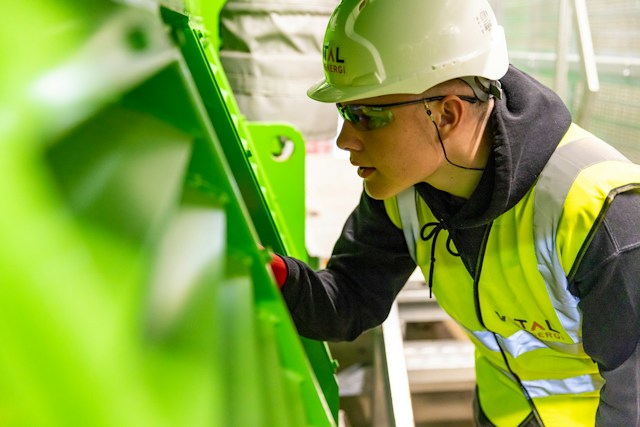
A technician in a hard hat and safety glasses inspects a piece of equipment
All projects
Healthcare

Keeping hospital thermodynamics under control

Client
Healthcare
Services
Maintenance, breakdown repair, cold rooms
Key figure
A check after a few cycles

The problem

MRI machines and other medical equipment rely on thermodynamics, which is our trade. They need a lot of maintenance: after a few operating cycles, every setting must be checked again, and any drift corrected immediately.

What we did

  • Regular maintenance of equipment that depends on thermodynamics
  • Checking each setting and correcting it immediately as soon as one drifts
  • Monitoring of the cold rooms in the mortuary department
The project in detail

How the job went

The context

Hospitals depend on equipment that most people never think of as thermodynamics. An MRI scanner relies on cooling to run, cold rooms must hold their temperature without exception, and heating has to stay stable in places where people are at their most vulnerable. This is exactly our trade, and it is why we are called in: the physics are the same as for a heat pump or a cold room, only the stakes are higher. These machines do not tolerate approximation. After a few operating cycles every setting has to be checked again, because a small drift that nobody sees today becomes a stoppage tomorrow.

Our work

Our work here is regular, methodical maintenance. We visit, test each parameter and compare it with what it should be. When one has drifted, we correct it immediately rather than noting it down for later. We also monitor the cold rooms of the mortuary department, where holding the right temperature is a matter of respect as much as of regulation. Every visit is written up in a service record, and where refrigerant is involved, the leak-tightness record goes with it: where a leak was, what was repaired, and how much gas was lost or recovered for destruction.

The result

What the hospital gets is equipment that stays within its settings, and a fast response if one ever leaves its range. We do not claim miracles: equipment like this needs attention, and the purpose of our visits is to be there before something becomes a problem. The key figure for this work is not a big number, it is a habit: a check after a few cycles, every time. That discipline, repeated visit after visit, is what keeps technical rooms quiet and unremarkable, which is exactly how they should be.

What changed

Equipment that stays within its settings, and a fast response if one of them drifts out of range.

Other projects

A project, a breakdown, a question?

Tell us what you need. We'll call you back, then either come out for a survey or send you a written quote.